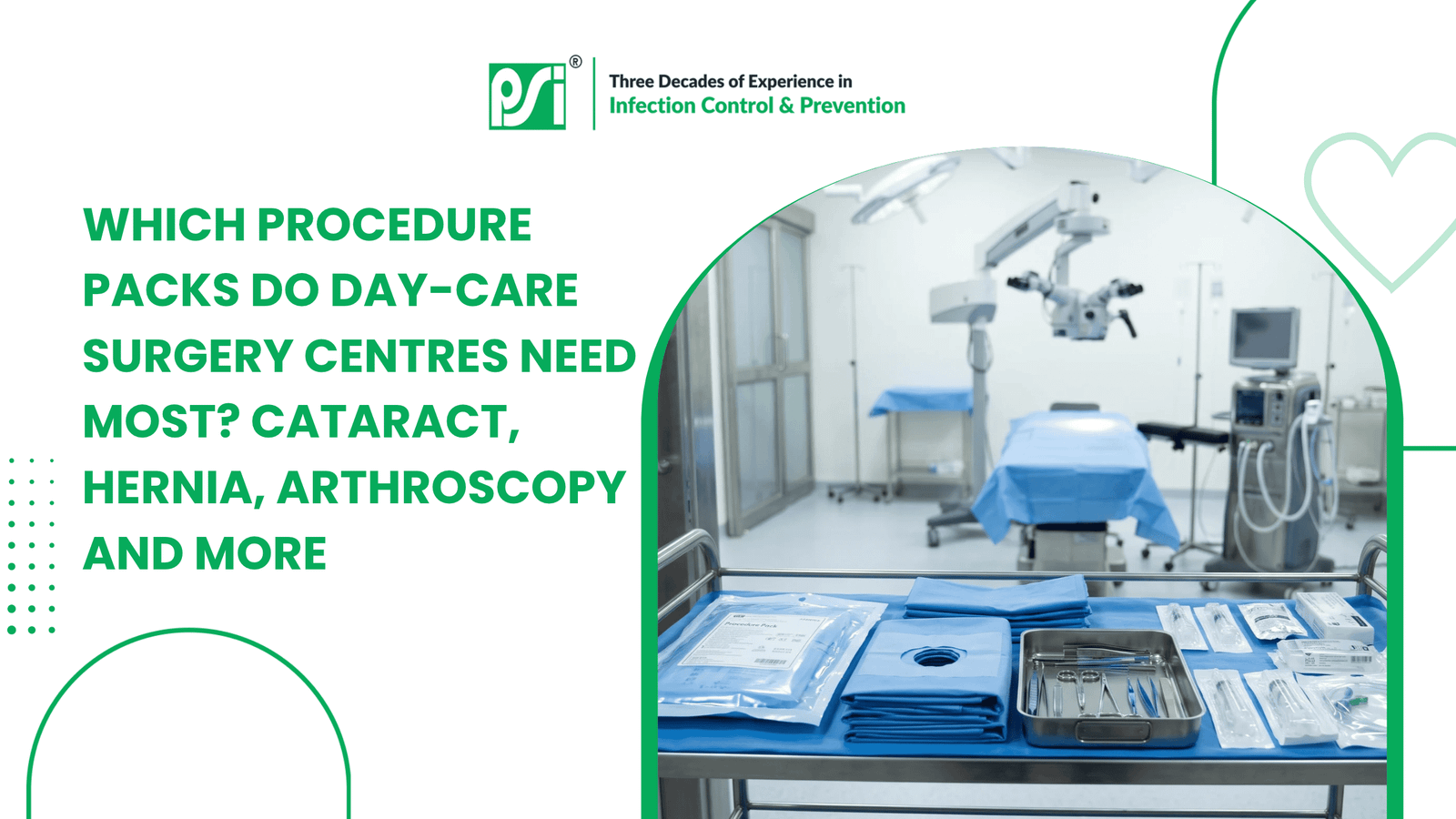
Which Procedure Packs Do Day-Care Surgery Centres Need Most? Cataract, Hernia, Arthroscopy and More
What happens when a day-care surgery centre has six procedures scheduled, but essential supplies are scattered across different storage areas?
Nurses spend valuable preparation time accumulating drapes, gowns, gauze, and other surgical consumables.
A missing item can interrupt the operating theatre workflow and delay the next procedure.
For day-care surgery centres, where efficient preparation and patient turnover matter, these interruptions can become costly.
This is where Procedure Packs make a practical difference.
Instead of collecting every disposable item separately, healthcare teams can use preconfigured packs designed for specific surgical procedures.
From cataract surgery to hernia repair and arthroscopy, different operations require different consumables.
A cataract procedure pack, for example, does not have the same requirements as an orthopaedic surgery pack.
Choosing the right configuration helps centres organise supplies, simplify preparation, and manage inventory more effectively.
However, a larger pack is not necessarily a better pack.
Unnecessary components increase costs and waste.
This guide explores seven useful procedure-pack categories for day-care surgery centres, their typical contents, and how to select suitable configurations.
It also explains how customised packs can support smoother clinical workflows.
What Are Surgical Procedure Packs?
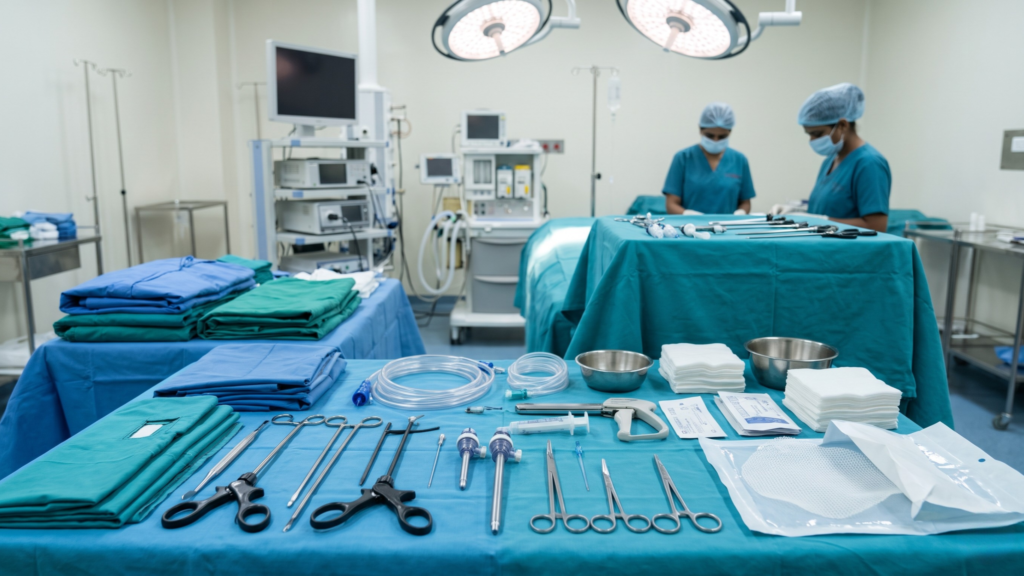
Surgical procedure packs are preconfigured collections of medical consumables prepared for specific surgical procedures.
They may contain sterile disposable supplies, protective materials, and other procedure-specific components.
Typical contents can be:
- Surgical drapes
- Disposable surgical gowns
- Gauze swabs
- Surgical towels
- Dressing materials
- Protective covers
- Syringes and other disposable accessories
- Procedure-specific consumables
The exact contents depend on the procedure, surgeon’s preferences, and manufacturer.
Some packs carry only basic consumables.
Others include additional sterile accessories.
Hospitals must confirm whether a pack is sterile and which components it includes.
Why Do Day-Care Surgery Centres Need Procedure Packs?
Day-care surgery centres perform selected procedures without requiring routine overnight hospital admission.
These facilities rely on organised preparation, appropriate patient selection, and efficient clinical workflows.
An obstruction in one procedure can affect the remaining operating schedule.
Custom surgical procedure packs help organise commonly required consumables before surgery begins.
They can assistt:
- Faster supply collection
- Consistent preparation
- Simplified inventory management
- Reduced individual packaging handling
- Easier procurement planning
- Better control over unnecessary supplies
However, packs do not replace surgical checklists, aseptic technique, or clinical judgement.
Their main role is to support organised supply preparation.
7 Procedure Packs Day-Care Surgery Centres Should Consider

The most useful packs depend on the procedures a centre performs.
The following seven categories provide a practical starting point.
1. Cataract Surgery Packs
Cataract surgery is a common procedure in ophthalmology day-care centres.
It requires carefully selected supplies for eye preparation, draping, and surgical support.
Cataract surgery packs may contain:
- Ophthalmic surgical drapes
- Eye towels
- Sterile gauze
- Disposable gowns
- Protective covers
- Selected ophthalmic accessories
The exact configuration depends on the surgical technique and equipment.
Some ophthalmology packs also contain equipment-specific consumables.
These must be established separately.
Why they matter: Cataract centres often perform multiple procedures during scheduled operating sessions.
Consistent pack configurations can simplify preparation between cases.
2. Hernia Surgery Packs
Selected hernia repairs can be performed as day-care procedures.
The required consumables depend on whether the surgery employs an open or laparoscopic approach.
Hernia surgery packs may include:
- Surgical drapes
- Sterile gowns
- Gauze swabs
- Surgical towels
- Dressing materials
- Protective covers
- Selected disposable accessories
Laparoscopic procedures may require additional equipment-specific consumables.
Surgical mesh, instruments, and specialised devices should not be assumed to be included.
Why they matter: Standardised supplies assist teams prepare consistently for frequently performed hernia procedures.
3. Arthroscopy Procedure Packs
Arthroscopy allows surgeons to examine and treat certain joint conditions using specialised instruments.
Selected knee and shoulder arthroscopy procedures may be suitable for day-care surgery.
Arthroscopy procedure packs may contain:
- Orthopaedic surgical drapes
- Fluid-resistant draping materials
- Disposable gowns
- Gauze swabs
- Protective covers
- Fluid-management accessories, where specified
- Dressing materials
Fluid management can be a chief consideration during arthroscopic procedures.
Hospitals should verify the pack’s barrier performance and compatibility with the surgical setup.
Why they matter: Suitable packs can organise draping and disposable supplies for orthopaedic teams.
4. Minor Surgery Packs
Minor surgical procedures are common in outpatient and day-care settings.
These may include selected skin procedures, wound closure, and other microscale operations.
Minor surgery packs may contain:
- Small surgical drapes
- Gauze swabs
- Dressing pads
- Disposable gloves
- Protective sheets
- Adhesive dressings
- Selected disposable accessories
A compact pack can be useful when the procedure requires relatively few consumables.
Why they matter: Smaller configurations can help circumvent opening unnecessary products.
5. Gynaecology Procedure Packs
Selected gynaecological procedures can be performed in day-care settings.
Examples include certain hysteroscopic and minor operative procedures.
Gynaecology procedure packs may contain:
- Appropriate surgical drapes
- Disposable gowns
- Gauze swabs
- Protective covers
- Absorbent materials
- Selected procedure-specific accessories
Requirements differ considerably between procedures.
Hospitals should avoid using one standard pack for every gynaecological operation.
Why they matter: Procedure-specific configurations can support more predictable preparation.
6. Urology Procedure Packs
Day-care centres may perform selected urological procedures.
Examples include certain cystoscopic and minor urological interventions.
Urology procedure packs may contain:
- Surgical drapes
- Disposable gowns
- Gauze swabs
- Protective sheets
- Fluid-management accessories, where required
- Dressing materials
- Selected sterile consumables
The pack should match the intended procedure and equipment.
Catheters, specialised instruments, and other devices require separate confirmation.
Why they matter: Structured consumables can simplify preparation for repeated urological procedures.
7. Endoscopy Procedure Packs
Endoscopy centres perform diagnostic and selected therapeutic procedures.
Their consumable requirements differ from those of conventional surgery.
Endoscopy procedure packs may contain:
- Protective drapes
- Disposable gowns
- Absorbent materials
- Protective covers
- Selected examination accessories
- Procedure-specific disposable supplies
Not every endoscopy procedure needs a sterile surgical pack.
The configuration should reflect the procedure’s infection-control requirements.
Why they matter: Appropriate packs can organise supplies without introducing unnecessary sterile components.
Which Procedure Packs Should Centres Prioritise First?
Not every day-care centre needs all seven categories.
A cataract-centred facility may prioritise ophthalmology packs.
An orthopaedic centre may need arthroscopy configurations more frequently.
A multispeciality centre may require several pack types.
Procurement teams should consider:
- Monthly procedure volumes
- Most frequently performed operations
- Current preparation time
- Commonly utilised consumables
- Surgeon preferences
- Storage capacity
- Product wastage
- Supplier lead times
The best starting point is usually the centre’s highest-volume, most standardised procedure.
What Does Research Say About Custom Surgical Packs?
A published study examines the economic impact of Alcon’s Custom Pak system in cataract and retinal surgery.
Researchers evaluate operating theatre preparation, supply management, and associated costs in United States healthcare facilities.
The study suggests that customised ophthalmology packs can decrease preparation time and certain hidden operational costs.
However, the findings relate to the products and settings studied.
They do not establish identical savings for every day-care centre.
A separate Canadian analysis also examines the potential efficiency benefits of comprehensive ophthalmology procedure packs.
These studies highlight an important purchasing consideration.
Hospitals should measure preparation and supply-management costs alongside the pack’s purchase price.
How Customised Procedure Packs Improve Workflow
A well-designed pack supports more than convenient packaging.
1. Simplifies Preparation
Staff can access selected consumables without collecting every item separately.
2. Supports Consistency
Repeated procedures can use an agreed supply configuration.
3. Reduces Unnecessary Handling
Fewer separately collected items may simplify supply preparation.
4. Supports Inventory Planning
Procurement teams can observe consumption by procedure type.
5. Helps Control Waste
Removing unnecessary components can reduce unused supplies.
6. Simplifies Reordering
Centres can purchase defined configurations instead of managing numerous individual items.
7. Supports Cost Visibility
A standardised pack can make disposable supply costs easier to track per procedure.
These benefits depend on appropriate pack design and actual clinical usage.
How to Choose the Right Procedure Pack Manufacturer
Selecting a supplier requires more than comparing catalogue prices.
Day-care surgery centres should evaluate several factors.
Step 1: Identify Procedure Requirements
List the operations performed and the consumables required for each.
Step 2: Consult Surgeons and Nurses
Clinical teams can identify essential items and unnecessary components.
Step 3: Review Material Specifications
Check drape materials, dimensions, barrier performance, and other relevant characteristics.
Step 4: Verify Sterility and Packaging
Confirm whether the complete pack is sterile and appropriately labelled.
Step 5: Evaluate Customisation Options
Ask whether the manufacturer can adjust quantities and components.
Step 6: Compare Total Costs
Include product costs, handling, storage, waste, and procurement expenses.
Step 7: Regulate a Trial
Evaluate suitable sample packs before placing large institutional orders.
Example: A Day-Care Centre Improves Surgical Preparation
Consider a multispeciality centre performing cataract, hernia, and arthroscopy procedures.
Its nursing team collects disposable supplies individually before every operation.
Different surgeons also request marginally different materials.
The centre decides to review its preparation process.
First, the team identifies commonly used consumables for each procedure.
Next, procurement staff evaluate three procedure-specific pack configurations.
The centre tests the packs during selected surgical sessions.
Nurses record missing components, unused products, and preparation time.
Surgeons provide feedback on product suitability.
The procurement team adjusts the configurations based on the results.
This illustrative example shows how customisation can support a more organised surgical workflow.
Common Mistakes When Purchasing Procedure Packs
Day-care surgery centres should avoid several common mistakes.
These include:
- Selecting oversized packs
- Ignoring surgeon preferences
- Purchasing without reviewing contents
- Assuming all packs are sterile
- Overlooking material specifications
- Ignoring expiry dates
- Failing to evaluate packaging integrity
- Ordering without testing samples
- Choosing suppliers based only on price
The objective is to purchase the right configuration rather than the largest possible pack.
How Plasti Surge Industries Supports Day-Care Surgery Centres
Plasti Surge Industries, known as PSI Dispo, manufactures medical disposables and healthcare consumables in India.
Its portfolio includes Procedure Packs for different surgical specialities.
These are:
- Ophthalmology
- General surgery
- Orthopaedics
- Gynaecology
- Urology
- Cardiology
- Neurology
PSI also manufactures surgical drapes, surgical gowns, sterile accessories, dressing kits, and protective apparel.
Its customised surgical procedure packs can support healthcare facilities seeking procedure-specific supply configurations.
Day-care surgery centres can discuss required components, materials, packaging, and institutional quantities with PSI.
The availability of individual cataract, hernia, arthroscopy, or endoscopy configurations should be confirmed immediately and directly.
Conclusion
Day-care surgery centres depend on organised preparation and reliable access to suitable medical consumables.
The accurate Procedure Packs can help clinical teams prepare consistently and manage supplies more efficiently.
Cataract, hernia, arthroscopy, minor surgery, gynaecology, urology, and endoscopy procedures may require different configurations.
However, no single pack suits every operation.
Centres should prioritise their most frequently performed procedures and review actual consumable requirements.
Customisation can help remove unnecessary components while retaining essential supplies.
Product quality, sterility, packaging, and clinical suitability must remain central to procurement decisions.
Plasti Surge Industries manufactures surgical procedure packs, drapes, gowns, and other medical disposables for healthcare institutions.
Looking for procedure-specific consumable solutions for your day-care surgery centre?
Contact Plasti Surge Industries to discuss customised pack configurations, product specifications, available components, and bulk institutional requirements.