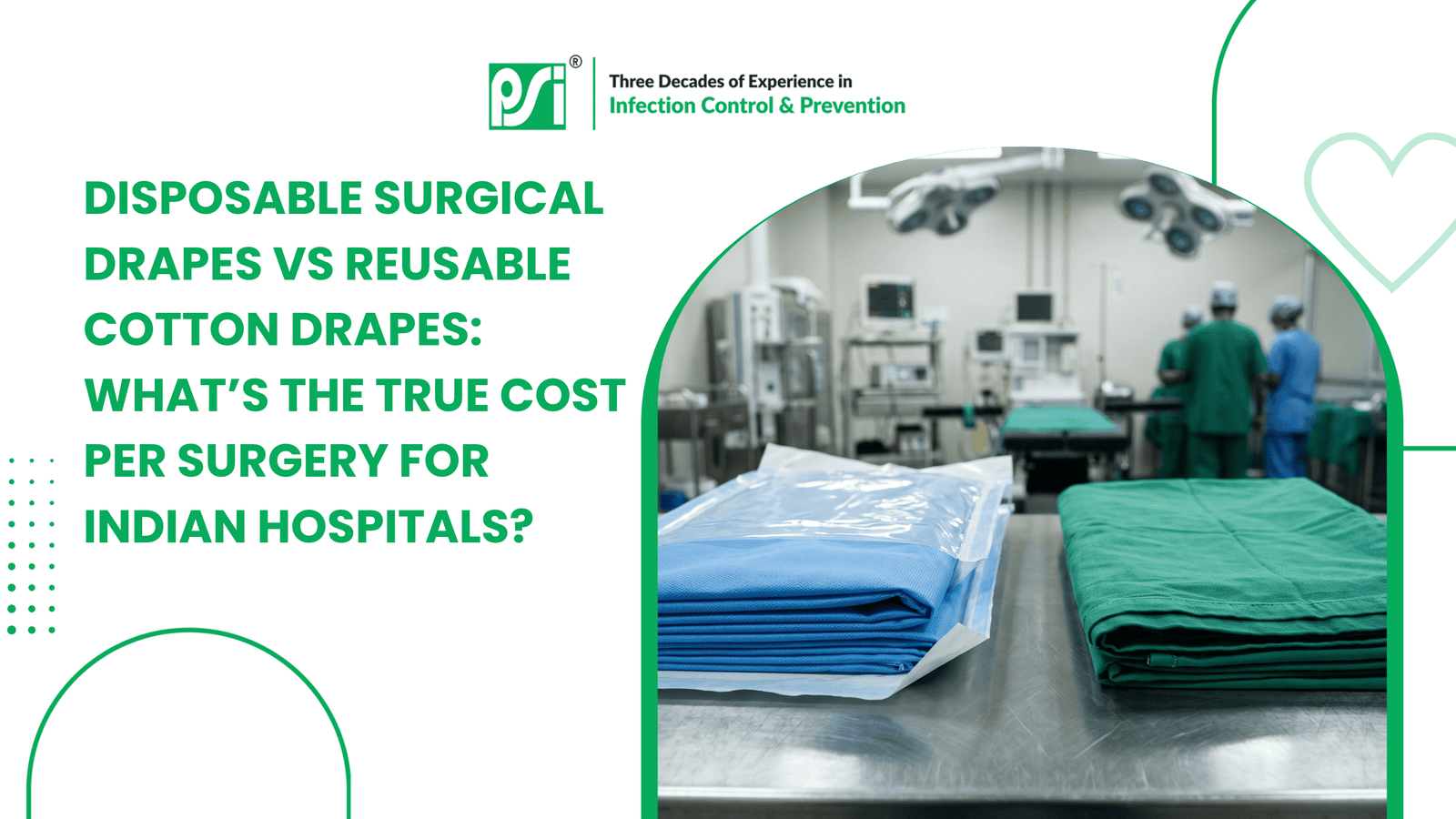
Disposable Surgical Drapes vs Reusable Cotton Drapes: What’s the True Cost per Surgery for Indian Hospitals?
A hospital purchases reusable cotton drapes because they appear cheaper than disposable alternatives.
But what happens when laundry, sterilisation, labour, and replacement costs enter the calculation?
The original price difference may look very different.
Every surgical procedure needs suitable draping to support the sterile field and protect the operative area.
Hospitals generally choose between single-use products and reusable draping systems.
Disposable Surgical Drapes usually involve a defined purchase cost for each procedure.
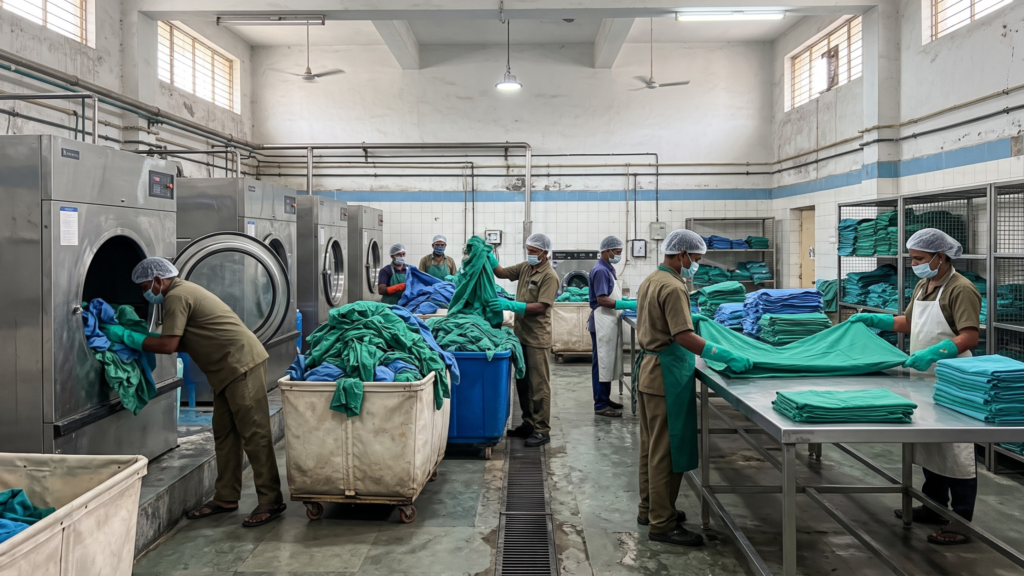
Reusable cotton drapes require repeated cleaning, inspection, packaging, and sterilisation before they return to service.
Both approaches involve additional expenses that procurement teams sometimes overlook.
For Indian hospitals managing high surgical volumes, these differences can greatly affect annual operating budgets.
However, cost is only one consideration.
Barrier performance, clinical suitability, waste management, and supply reliability also matter.
A cheaper product provides little value if it fails to meet the required clinical specifications.
So, which option actually costs less per surgery?
This guide compares the complete costs of disposable and reusable drapes.
It also provides an illustrative Indian hospital calculation and practical purchasing recommendations.
What Are Disposable and Reusable Surgical Drapes?
Surgical drapes help generate an appropriate barrier around the operative area.
Hospitals use different draping materials depending on their clinical requirements.
Disposable Surgical Drapes
Disposable drapes are designed for single use.
They commonly use nonwoven materials and are available in different sizes and configurations.
Depending on the product, they may offer:
- Fluid-resistant materials
- Procedure-specific designs
- Sterile packaging
- Fenestrations or openings
- Adhesive positioning features
- Compatibility with procedure packs
After use, hospitals dispose of them according to applicable waste-management requirements.
Reusable Cotton Drapes
Reusable cotton drapes are designed for repeated use when suitable for their intended application.
They require appropriate laundering, inspection, packaging, and sterilisation between procedures.
Their usable life depends on:
- Fabric quality
- Washing conditions
- Sterilisation cycles
- Physical damage
- Barrier performance
- Manufacturer instructions
Traditional cotton drapes should not automatically be considered equivalent to modern reusable barrier fabrics.
Hospitals must verify the actual material performance.
Why Purchase Price Alone Is Misleading
Visualize two suppliers offering different draping solutions.
One quotes a disposable drape set at ₹650 per surgery.
Another offers a reusable cotton set for ₹2,400.
At first glance, the reusable option looks expensive.
However, that set may support multiple procedures.
The hospital must therefore divide its purchase cost across its usable life.
It must also include every reprocessing expense.
The correct comparison is total cost per procedure, not the original purchase price.

7 Costs Hospitals Should Include
1. Initial Purchase Cost
Disposable products have a purchase cost for every use.
Reusable products have an initial purchase cost spread across multiple uses.
2. Laundry Expenses
Reusable drapes require appropriate cleaning after use.
Laundry costs can include:
- Water
- Detergents
- Electricity
- Equipment
- Labour
- Wastewater treatment
These costs vary between hospitals.
3. Sterilisation Costs
Reusable drapes require validated reprocessing before employment for surgery.
Relevant expenses can include:
- Sterilisation equipment
- Utilities
- Packaging materials
- Staff time
- Monitoring and quality checks
- Equipment maintenance
Hospitals should calculate these expenses per drape set.
4. Inspection and Replacement
Reusable materials deteriorate with repeated processing.
Hospitals must inspect them and remove unsuitable products from service.
Replacement costs increase when drapes wear out earlier than expected.
5. Storage and Handling
Both systems require storage and inventory management.
Reusable drapes also require motion between operating theatres, laundry facilities, and sterilisation departments.
6. Waste Disposal
Disposable drapes create waste after use.
Disposal costs depend on contamination, material, waste classification, and local regulations.
Reusable systems also generate waste through mutilated products, packaging, and reprocessing activities.
7. Staff Preparation Time
Drape preparation can affect operating theatre workflows.
Some Prepacked Surgical Drapes simplify supply collection and setup.
However, time savings depend on the product configuration and existing hospital processes.
What Is the True Cost per Surgery?
Hospitals can employ a simple calculation.
Disposable cost per surgery = Purchase price + Handling + Waste disposal + Other applicable costs
Reusable cost per surgery = Purchase cost ÷ Actual usable cycles + Laundry + Sterilisation + Inspection + Handling + Other applicable costs
The following example demonstrates how the calculation works.
Illustrative Cost Comparison for an Indian Hospital
Consider a hospital comparing draping supplies for one type of surgery.
Both options must meet the same clinical requirements.
Disposable Draping System
| Cost component | Cost per surgery |
| Disposable drape set | ₹650 |
| Handling and storage | ₹20 |
| Waste disposal | ₹60 |
| Total | ₹730 |
Reusable Cotton Draping System
Assume the reusable set costs ₹2,400 and remains suitable for 30 procedures.
| Cost component | Cost per surgery |
| Purchase cost: ₹2,400/ 30 | ₹80 |
| Laundry | ₹110 |
| Sterilisation | ₹180 |
| Inspection and handling | ₹45 |
| Replacement allowance | ₹35 |
| Total | ₹450 |
The replacement allowance represents additional expected losses beyond the planned 30-use lifespan.
All figures are hypothetical and exclude costs common to both systems.
What Does This Mean?
Disposable cost: ₹730 per surgery.
Reusable cost: ₹450 per surgery.
Illustrative difference: ₹280 per surgery.
For 1,000 comparable procedures, the difference reaches ₹2,80,000.
However, this does not prove reusable drapes are always cheaper.
Actual results depend on prices, processing costs, lifespan, and product specifications.
When Can Disposable Drapes Be More Cost-Effective?
Disposable Surgical Drapes may offer operational advantages in definite circumstances.
These include hospitals with:
- Limited laundry capacity
- High outsourced reprocessing costs
- Unpredictable surgical volumes
- Complex procedure-specific requirements
- Limited reusable inventory
- High textile loss or damage rates
Disposable products may also simplify inventory planning when supplied in ready-to-use configurations.
However, these advantages need financial verification.
When Can Reusable Cotton Drapes Cost Less?
Reusable systems may offer lower costs when hospitals have effective reprocessing facilities.
Favourable conditions can include:
- Reliable laundry infrastructure
- Efficient sterilisation
- High surgical volumes
- Low textile loss
- Suitable reusable materials
- Long validated service life
The hospital must still verify that the drapes maintain the required barrier performance.
A low cost per use does not justify unsuitable surgical protection.
What Does Published Research Show?
Research demonstrates why hospitals should evaluate their own operating costs.
A 2021 study at a Turkish medical centre compares disposable and reusable surgical drapes.
Researchers report that reusable drapes offer approximately 33.74% annual cost savings in the studied hospital.
However, the result mirrors that facility’s prices and operating conditions.
Another published study compares cotton, disposable nonwoven, and reusable polyester drapes.
Its analysis finds different costs per use across the three materials.
The results also show that reusable polyester can perform differently from conventional cotton.
These findings support one important conclusion.
There is no universal cost winner for every hospital.
Are Disposable Drapes Safer Than Reusable Cotton Drapes?
Safety depends on more than whether a drape is disposable.
The World Health Organization supports either sterile disposable nonwoven or sterile reusable woven drapes for surgical use.
Available evidence does not establish that disposable drapes consistently lessen surgical-site infections compared with reusable alternatives.
However, material performance remains essential.
Hospitals should evaluate:
- Fluid-barrier performance
- Microbial-barrier requirements
- Material integrity
- Sterility
- Intended use
- Relevant standards
Repeatedly processed cotton must continue meeting applicable performance requirements.
What About Environmental Costs?
Environmental collision adds another dimension to procurement.
Disposable drapes can generate substantial material and packaging waste.
Reusable drapes require water, energy, detergents, and reprocessing infrastructure.
The overall impact depends on the complete product lifecycle.
Hospitals should contemplate:
- Material production
- Transportation
- Packaging
- Laundry
- Sterilisation
- Water consumption
- Energy use
- Waste disposal
A proper lifecycle assessment provides more meaningful information than simply comparing waste weight.
How Prepacked Surgical Drapes Can Simplify Procurement
Prepacked Surgical Drapes can help hospitals organise procedure-specific supplies.
Instead of collecting multiple products separately, staff receive a defined configuration.
Potential advantages include:
- Easier preparation
- Consistent drape selection
- Simplified stock management
- Fewer individual packages
- More predictable purchasing
- Reduced unnecessary handling
However, packs can also create waste when they hold unnecessary components.
Hospitals should review actual product usage before finalising pack configurations.
How to Choose the Right Draping System
Hospitals can follow seven practical steps.
Step 1: Identify Clinical Requirements
Define the procedures, barrier requirements, dimensions, and sterility specifications.
Step 2: Calculate Actual Purchase Costs
Obtain quotations for clinically comparable disposable and reusable systems.
Step 3: Measure Reprocessing Expenses
Include laundry, sterilisation, inspection, utilities, and labour.
Step 4: Review Reusable Lifespan
Employ actual hospital records rather than assuming unlimited reuse.
Step 5: Calculate Disposal Costs
Include the appropriate waste-management costs for each option.
Step 6: Conduct a Trial
Evaluate handling, preparation, material performance, and staff feedback.
Step 7: Compare Total Cost per Surgery
Select the system that meets clinical requirements and offers the best overall value.
Example: A Hospital Reviews Its Draping Budget
Consider a 250-bed hospital performing approximately 300 surgeries every month.
The procurement team notices rising expenditure on surgical consumables.
Instead of immediately switching suppliers, it reviews its existing draping system.
The team gathers information about:
- Drape purchase prices
- Laundry expenses
- Sterilisation costs
- Staff preparation time
- Textile replacement
- Waste disposal
- Procedure-specific requirements
It then compares disposable and reusable alternatives.
Clinical teams evaluate samples for suitability and barrier performance.
The hospital chooses products based on the combined clinical and financial findings.
This illustrative example demonstrates a more informed purchasing approach.
What Should Hospitals Look for in a Drape Manufacturer?
A reliable Single-Use Drapes Manufacturer should provide clear product information.
Hospitals should evaluate:
- Material specifications
- Barrier performance
- Sterility requirements
- Product dimensions
- Packaging integrity
- Relevant quality documentation
- Procedure-specific options
- Manufacturing capacity
- Supply reliability
- Bulk-order requirements
The cheapest quotation does not automatically represent the best procurement decision.
How Plasti Surge Industries Supports Surgical Draping Needs
Plasti Surge Industries, known as PSI Dispo, manufactures medical disposables and healthcare consumables in India.
Its portfolio includes surgical drapes, gowns, sterile accessories, and procedure packs.
PSI proffers draping solutions for different surgical specialities, including:
- General surgery
- Orthopaedics
- Gynaecology
- Ophthalmology
- Urology
- Cardiology
- Neurology
Hospitals can discuss drape specifications, procedure requirements, packaging, and bulk quantities with PSI.
Customised procedure packs may also support hospitals seeking more organised surgical supply configurations.
When evaluating a Single-Use Drapes Manufacturer, buyers should request specifications for the exact products under consideration.
Conclusion
Choosing between disposable and reusable surgical drapes requires more than comparing supplier quotations.
Hospitals need to understand the complete cost of each system.
Disposable drapes involve recurring purchase and disposal expenses.
Reusable cotton drapes need laundering, sterilisation, inspection, handling, and eventual replacement.
Both options can be suitable when they meet the required clinical and barrier-performance standards.
The better financial choice depends on actual hospital conditions.
Indian hospitals should calculate cost per surgery using their own procurement and operating data.
They should also consider workflow efficiency, waste management, and product availability.
Plasti Surge Industries manufactures surgical drapes, procedure packs, and other medical disposables for healthcare institutions.
Looking for surgical draping solutions that suit your hospital’s clinical and procurement needs?
Contact Plasti Surge Industries to discuss product specifications, procedure-specific draping options, bulk quantities, and institutional requirements.