Why Eco-Friendly Medical Disposables Are Trending
Why Eco-Friendly Medical Disposables Are Trending
Can healthcare protect patients while also reducing its impact on the environment?
Hospitals globally increasingly ask this question.
Modern healthcare depends heavily on single-use products because hygiene, infection control, convenience, and clinical safety remain essential.
However, every disposable product eventually becomes waste.
This creates growing interest in eco-friendly medical disposables that balance clinical requirements with more responsible material and waste choices.
The switch is not simply about replacing plastic with another material.
Hospitals increasingly examine packaging, procurement, waste segregation, product design, disposal methods, and the complete product lifecycle.
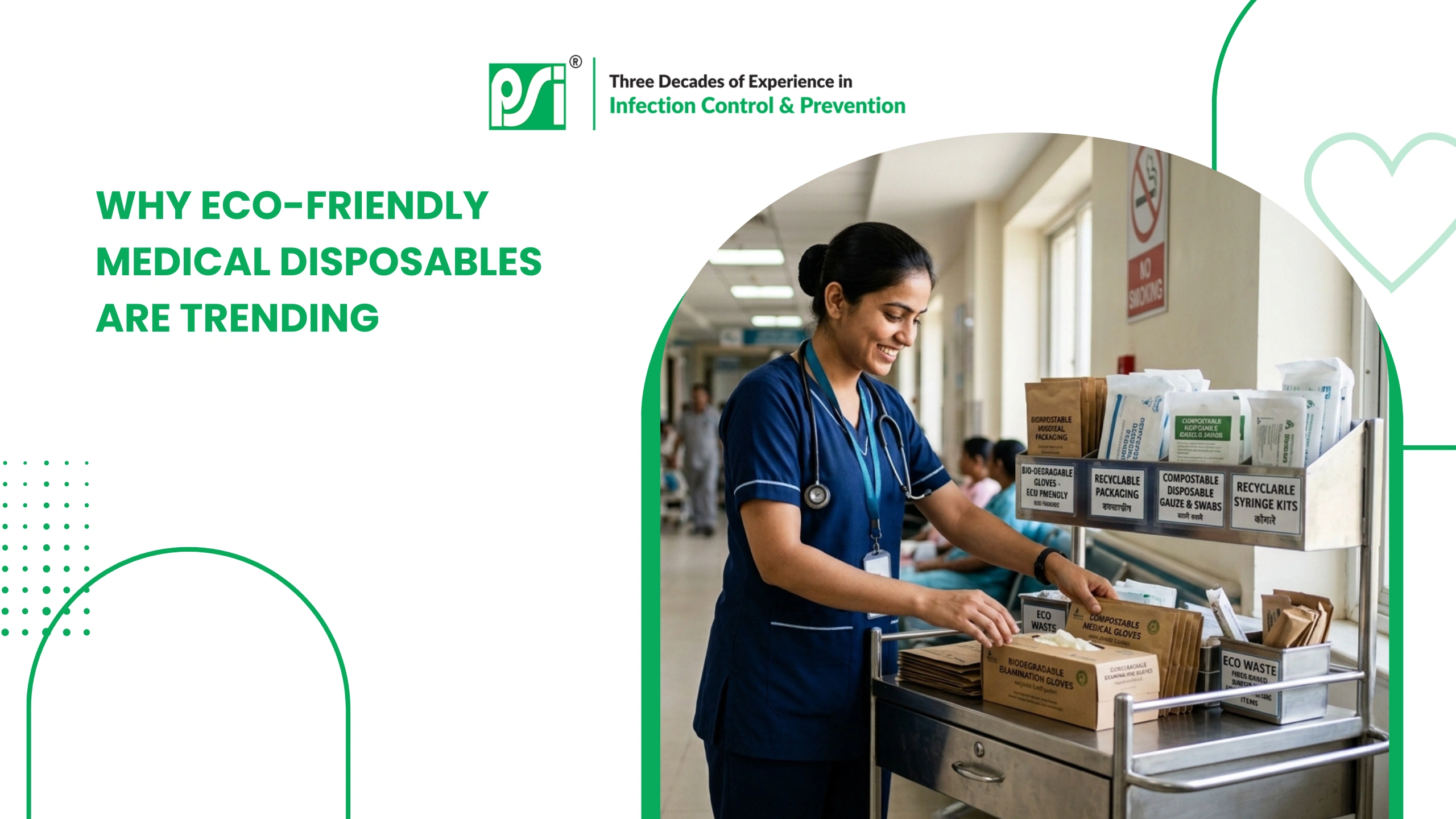
Manufacturers also investigate sustainable medical products and compostable alternatives for suitable healthcare applications.
For procurement teams, sustainability therefore becomes another factor alongside safety, quality, performance, compliance, availability, and cost.
So, why is this trend gaining momentum?
This blog explores the major hospital sustainability trends, explains biodegradable options, and shows what healthcare buyers should consider before making the switch.
What Are Eco-Friendly Medical Disposables?
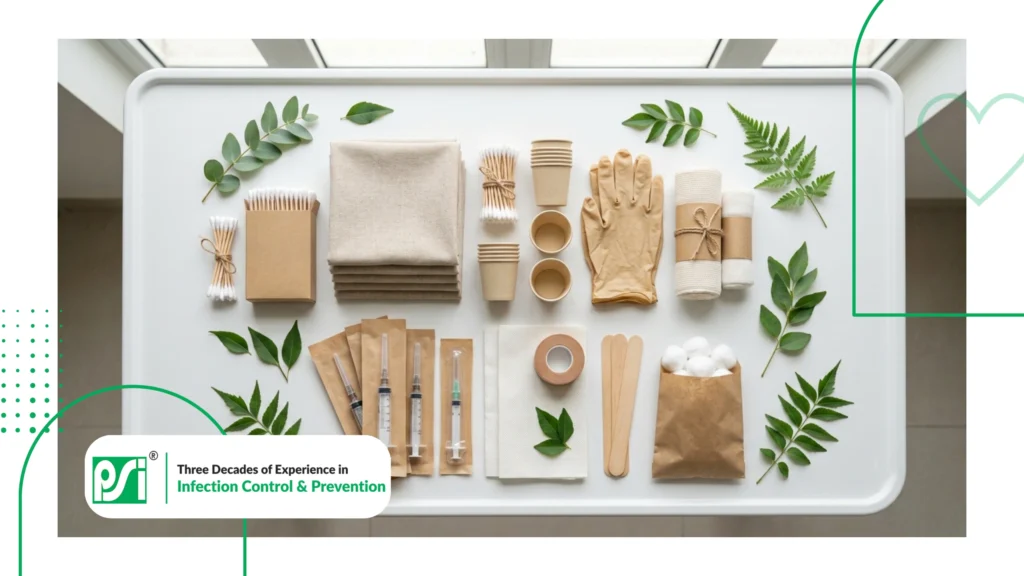
Eco-friendly medical disposables aim to reduce environmental impact while still meeting their intended performance requirements.
Depending on the product, improvements may involve:
- Alternative materials
- Compostable materials
- Reduced plastic content
- Lower material consumption
- Reduced packaging
- Better waste segregation
- Responsible manufacturing
- More efficient transportation
The key word is appropriate.
Not every traditional medical disposable has an immediate sustainable replacement.
Why Healthcare Waste Is Receiving More Attention
Healthcare facilities generate several different waste streams.
These comprise general waste, infectious materials, sharps, pharmaceuticals, chemicals, and other hazardous products.
Hospitals must manage each category correctly.
This makes sustainability more complex than simply putting a “green” label on a product.
The priority remains protecting patients, healthcare workers, waste handlers, and communities.
Sustainability works alongside safety rather than replacing it.

7 Reasons Eco-Friendly Medical Disposables Are Trending
1. Hospitals Generate Significant Waste
Single-use healthcare products contribute to the materials hospitals discard every day.
This makes waste reduction an increasingly important procurement conversation.
Hospitals examine where they can safely reduce unnecessary materials without affecting patient care.
That creates possibilities for eco-friendly medical disposables in suitable applications.
2. Sustainable Procurement Is Growing
Healthcare procurement teams increasingly look beyond the purchase price.
They may also consider:
- Product materials
- Packaging volume
- Transportation requirements
- Waste generation
- Disposal requirements
- Supplier sustainability practices
- Product lifecycle
This creates pressure for manufacturers that can discuss both performance and environmental impact.
3. Packaging Is Under Scrutiny
The product itself is only part of the waste equation.
Medical products often require packaging to safeguard cleanliness, sterility, or product integrity.
However, manufacturers can still examine opportunities to reduce unnecessary secondary packaging.
Efficient packaging can also reduce storage and transportation requirements.
4. Biodegradable Alternatives Are Expanding
Interest and scrutiny in biodegradable healthcare supplies continues to grow.
However, buyers should understand exactly what claims such as biodegradable or compostable mean.
A product does not necessarily disappear harmlessly after disposal.
Degradation depends on:
- Material composition
- Temperature
- Moisture
- Microbial activity
- Disposal conditions
- Industrial composting availability
Hence, hospitals should ask manufacturers for clear material and disposal information.
5. Healthcare Organisations Have Sustainability Targets
Environmental performance increasingly becomes part of broader healthcare planning.
Hospitals may establish goals around:
- Waste reduction
- Carbon emissions
- Energy consumption
- Water use
- Responsible procurement
- Recycling
- Sustainable supply chains
Medical consumables become an apparent area for review because facilities purchase them continuously.
6. Waste Segregation Can Reduce Environmental Impact
Sustainability is not only about changing products.
Correct segregation also matters.
General waste should not unnecessarily enter hazardous medical waste streams.
Better segregation can reduce the volume needing specialised treatment.
Hospitals therefore need products and waste systems that work together.
7. Suppliers Are Innovating
Medical manufacturers increasingly recognise that buyers want alternatives.
This encourages innovation in materials, packaging, manufacturing processes, and product configurations.
PSI Dispo, for example, includes an Eco Friendly Compostable category within its healthcare product portfolio.
This mirrors the wider movement toward exploring sustainable alternatives for suitable healthcare uses.
Are Biodegradable Healthcare Supplies Always Better?
Not automatically.
This is one of the most important points for healthcare buyers.
A sustainable product must still perform its planned function safely.
Hospitals should assess:
- Clinical suitability
- Material performance
- Required certifications
- Storage conditions
- Shelf life
- Disposal requirements
- Availability of composting infrastructure
- Total lifecycle impact
A biodegradable product sent through an unsuitable waste stream may not deliver its intended environmental benefit.
Good procurement requires evidence rather than assumptions.
Sustainable Does Not Mean Compromising Infection Control
Patient safety remains non-negotiable.
Hospitals should never opt for a product solely because its packaging describes it as environmentally friendly.
Clinical suitability comes first.
Healthcare buyers should substantiate applicable quality, performance, safety, and regulatory requirements before introducing any alternative product.
Sustainability then becomes part of a broader buying decision.
How Hospitals Can Start Making the Transition
Changing every disposable product immediately is neither practical nor necessary.
Hospitals can start with a structured review.
Step 1: Conduct a Waste Audit
Pinpoint which disposable products generate the highest waste volumes.
Separate hazardous and non-hazardous waste categories.
Step 2: Identify Easy Opportunities
Look for areas where more sustainable alternatives already converge required performance specifications.
Step 3: Review Packaging
Ask suppliers whether packaging or shipping materials can be reduced without affecting product protection.
Step 4: Compare Alternatives
Evaluate environmental claims alongside clinical performance, quality, price, availability, and disposal requirements.
Step 5: Run a Controlled Trial
Introduce selected products within one department.
Gather feedback from clinical and procurement teams.
Step 6: Measure the Result
Collate waste volumes, product consumption, usability, and cost before expanding the programme.
Example: A Smarter Hospital Waste Strategy
Envisage a hospital reviewing its disposable purchasing.
The procurement team identifies several high-volume non-hazardous products and excessive secondary packaging.
Instead of changing everything, the hospital prioritises selected categories.
The team:
- Reviews alternative products
- Consults clinical staff
- Checks certifications
- Studies disposal requirements
- Improves waste segregation
- Requests reduced packaging
- Tracks consumption
The hospital gradually creates a more sustainable purchasing system without compromising clinical requirements.
This measured approach is more realistic than switching products simply because they carry an environmental contention.
What Buyers Should Ask Sustainable Medical Product Suppliers
Before selecting sustainable medical products, procurement groups should ask:
- What materials does the product use?
- What makes the product environmentally preferable?
- Is the entire product biodegradable?
- Is it certified compostable?
- What disposal conditions does it require?
- Does it need industrial composting?
- What certifications apply?
- Is the packaging recyclable or reduced?
- How does performance compare with conventional alternatives?
- Can the manufacturer provide supporting documentation?
Specific questions help buyers separate genuine improvements from vague environmental marketing.
The Role of Manufacturers
Manufacturers play an important role in future hospital sustainability trends.
Their responsibilities extend beyond creating alternative materials.
They can also support sustainability through:
- Smarter product design
- Efficient manufacturing
- Appropriate material selection
- Reduced unnecessary packaging
- Customised healthcare kits
- Better product documentation
- Responsible supply chains
Customisation can also help decrease unnecessary consumption.
Procedure packs containing only required components may help prevent unused items from becoming waste.
Why PSI Dispo Fits the Sustainability Conversation
Plasti Surge Industries provides medical disposables and healthcare solutions across several clinical categories.
Its portfolio comprises surgical gowns, sterile accessories, procedure packs, protective apparel, dressing kits, and customised healthcare kits.
PSI also lists an Eco Friendly Compostable category within its product portfolio.
For healthcare buyers, this creates an opportunity to discuss sustainability alongside practical clinical and procurement requirements.
Hospitals can survey where alternative products make sense rather than adopting a one-size-fits-all approach.
Conclusion
Eco-friendly medical disposables represent an important direction for healthcare, but sustainability requires more than changing materials.
Hospitals need to examine what they purchase, how much they use, how products arrive, and what happens after disposal.
The strongest strategy merges clinical safety with smarter procurement, responsible materials, better segregation, reduced packaging, and measurable waste reduction.
As hospital sustainability trends develop, manufacturers and healthcare providers need to work together.
Plasti Surge Industries already provides medical disposables, customised healthcare solutions, and an Eco Friendly Compostable product category.
Healthcare organisations looking to investigate sustainable alternatives can contact PSI Dispo to discuss product requirements, applications, quantities, and suitable options.