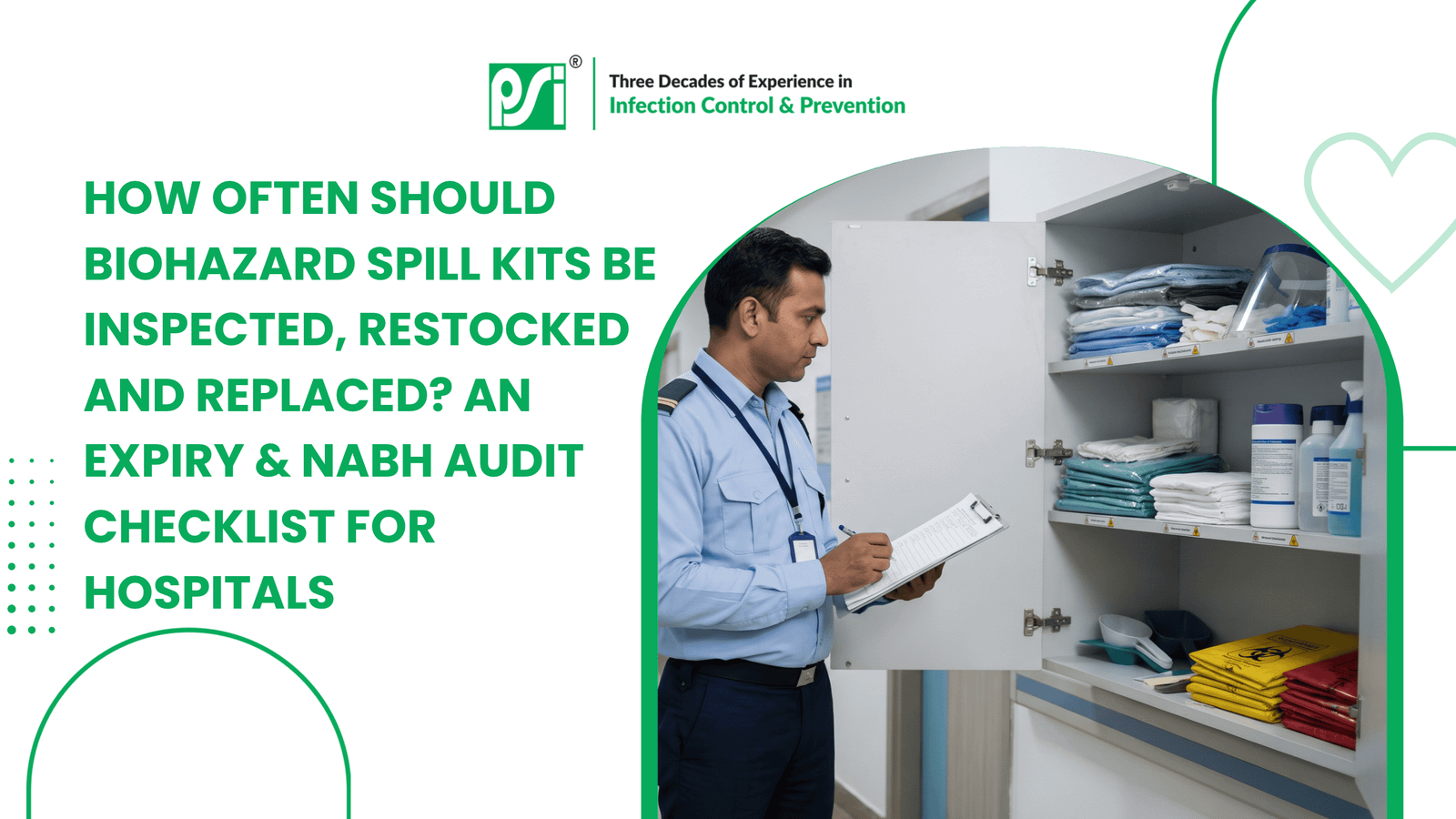
How Often Should Biohazard Spill Kits Be Inspected, Restocked and Replaced? An Expiry & NABH Audit Checklist for Hospitals
Imagine a nurse locating a blood spill in a busy hospital corridor.
The nearest spill kit is available, but its gloves are missing and the disinfectant has expired.
The hospital has a kit, yet the team cannot rely on it for an appropriate response.
This situation highlights an important lesson: owning spill kits is not the same as maintaining them.
Biohazard Spill Kits help healthcare workers manage blood and other potentially infectious body-fluid spills securely.
However, their effectiveness depends on complete contents, suitable storage, and regular inspection.
Hospitals must also ensure staff understand the correct response procedures.
For Indian healthcare facilities, NABH accreditation adds another reason to maintain documented infection-control practices.
But how often should hospitals inspect, restock, or replace these kits?
Does every component have the same expiry date?
And what evidence should hospital teams maintain for an accreditation assessment?
This guide answers these questions with a practical inspection schedule, expiry-management recommendations, and an NABH-focused checklist.
It also explains how to avoid common maintenance mistakes and keep spill-response supplies ready for use.
What Are Biohazard Spill Kits?
Biohazard spill kits contain supplies for managing spills involving blood and potentially infectious body fluids.
They support containment, cleaning, disinfection, and appropriate waste disposal.
Depending on their design, Biological Spill Response Kits may contain:
- Protective gloves
- Face masks or eye protection
- Disposable gowns or aprons
- Absorbent granules or pads
- Scoops or scrapers
- Suitable disinfectants
- Waste-collection bags
- Spill-response instructions
The exact contents rely on the manufacturer and the hazards covered.
Hospitals should select kits according to their infection-control policies and workplace risk assessments.
Why Is Regular Spill Kit Inspection Important?
A spill kit may remain unused for months.
However, its contents can still become unsuitable.
Disinfectants may expire, packaging may deteriorate, and supplies may disappear after partial usagee.
Regular inspection helps hospitals identify these problems before an emergency.
It also supports:
- Faster access to appropriate supplies
- Consistent spill-response readiness
- Better inventory control
- Early identification of expired products
- Safer storage practices
- Documented infection-control monitoring
A kit is only useful when its components are suitable and available.
How Often Should Biohazard Spill Kits Be Inspected?
There is no single inspection frequency that suits every hospital.
The appropriate schedule depends on usage, location, manufacturer instructions, and institutional policies.
Hospitals can utilise the following practical framework.
| Inspection activity | Suggested Frequency | Main Purpose |
| Visual accessibility check | Daily in high-use areas | Confirm the kit is present and accessible |
| Contents and expiry inspection | Monthly | Identify missing, damaged, or expiring components |
| Restocking | Immediately after use | Restore the kit to its approved contents |
| Detailed inventory review | Quarterly | Review usage, records, and replacement needs |
| Policy and programme review | At least annually, or as required | Review procedures, responsibilities and training |
These intervals are suggested internal practices.
Hospitals should follow applicable requirements and their approved infection-control procedures.

Daily Checks
A daily visual check can be useful in high-risk departments.
These comprise:
- Emergency departments
- Operating theatres
- Laboratories
- Dialysis units
- Intensive care units
- High-traffic patient areas
Staff can confirm that the kit is accessible, correctly located, and visibly undamaged.
Monthly Checks
Monthly inspections provide an opportunity to review individual components.
The assigned staff member checks quantities, expiry dates, packaging, and storage conditions.
Any missing or unsuitable item needs replacement.
Checks After Every Use
Restocking should happen immediately after the kit is used.
Even a partially used kit may lack essential supplies.
Staff should not assume that unused-looking components remain complete.
The kit should return to service only after its approved inventory is restored.
When Should Spill Kit Components Be Replaced?
Not every component has the same replacement requirements.
Some products have manufacturer-defined expiry dates.
Others require replacement when damaged, contaminated, or unsuitable.
1. Expired Disinfectants
Disinfectants require particular attention.
Their effectiveness depends on formulation, storage, preparation, and manufacturer instructions.
Hospitals should check:
- Expiry date
- Container integrity
- Storage conditions
- Dilution requirements
- In-use shelf life
- Required contact time
Prepared disinfectant solutions may have shorter usable periods than unopened products.
Never surmise that an expired disinfectant remains effective.
2. Damaged Protective Equipment
Gloves, masks, and protective clothing require suitable packaging and storage.
Replace products showing:
- Tears
- Punctures
- Deterioration
- Contamination
- Damaged packaging
- Expired shelf life, where applicable
3. Missing Absorbent Materials
Absorbent pads and granules are paramount components of many Biological Spill Clean Up Kits.
Inspect them for moisture damage, contamination, and missing quantities.
Replace any material that no longer meets the manufacturer’s requirements.
4. Damaged Waste-Collection Supplies
Waste bags and collection accessories must remain suitable for their intended use.
Check for tears, damage, missing closures, or other defects.
5. Missing Instructions
Clear instructions aid trained staff follow the approved response procedure.
Replace missing, damaged, or outdated instruction sheets.
Does the Entire Spill Kit Have One Expiry Date?
Not necessarily.
A spill kit may contain several products with different shelf lives.
For example:
- Disinfectant: manufacturer-defined expiry or in-use period
- Gloves: applicable manufacturer shelf life
- Absorbents: manufacturer-defined storage and replacement conditions
- Waste bags: condition and applicable manufacturer requirements
- Instructions: replace when damaged or outdated
Hospitals should record component-level expiry information.
Where a complete kit carries a manufacturer-assigned expiry date, follow that date.
Do not create an arbitrary expiry period for every kit.
NABH Audit Checklist for Hospital Spill Kits
NABH accreditation focuses on organised infection prevention, safety practices, documentation, and staff preparedness.
Hospitals should maintain evidence that their spill-response arrangements work in practice.
The following checklist assists internal readiness reviews.
Spill Kit Availability
- Kits are available at identified locations.
- Staff can access kits without unnecessary delay.
- Kit locations are clearly identified.
- The number and placement of kits indicate departmental risks.
Contents and Condition
- Each kit matches its approved inventory.
- Required PPE is available.
- Absorbent materials are present.
- Suitable disinfectants are available.
- Packaging remains intact.
- Expired or damaged components are replaced.
Documentation
- Inspection records are maintained.
- Inspection dates are recorded.
- Responsible staff members are identified.
- Expiry dates are monitored.
- Restocking activities are documented.
- Corrective actions are recorded.
Staff Preparedness
- Relevant staff obtain spill-response training.
- Staff understand when to escalate a spill.
- Appropriate PPE selection is covered.
- Staff understand approved cleaning procedures.
- Waste disposal follows applicable requirements.
- Training and competency records are available.
Infection-Control Procedures
- The hospital maintains written spill-response procedures.
- Procedures address relevant biological hazards.
- Appropriate disinfectants and contact times are specified.
- Staff understand incident reporting requirements.
- Procedures are reviewed according to hospital policy.
This checklist supports internal estimation.
It does not replace the applicable NABH accreditation standards or statutory requirements.

What Does NABH Actually Require?
NABH’s hospital accreditation framework addresses infection prevention and control through documented programmes and risk-management practices.
Its infection-control guidance includes written procedures, monitoring, staff responsibilities, and periodic review.
NABH’s published hospital infection-control checklist also asks whether hazardous spills, including blood, are managed appropriately.
It specifically considers whether staff get training and can demonstrate the required response.
However, hospitals should not assume NABH prescribes a universal monthly spill-kit inspection interval.
Inspection frequency should follow the hospital’s documented risk-based policy and applicable requirements.
How to Maintain a Spill Kit Inspection Register
A simple register helps hospitals demonstrate routine monitoring.
It can include:
| Field | Example |
| Department | Emergency Department |
| Kit identification | ED-SP-01 |
| Inspection date | 18th November 2026 |
| Inspector | Assigned nursing supervisor |
| Inventory status | One item missing |
| Expiry status | Disinfectant approaching expiry |
| Corrective action | Replace missing item and disinfectant |
| Closure status | Pending verification |
These entries are illustrative.
A digital register can also support expiry reminders and inventory reporting.
However, a paper register works when it is invariably maintained.
Example: A Hospital Finds an Expired Spill Kit
Consider a hospital preparing for an internal infection-control audit.
The quality team reviews spill kits across several departments.
During inspection, one kit contains expired disinfectant and missing gloves.
The assigned supervisor removes the unsuitable components.
Replacement supplies are obtained and checked against the approved inventory.
The team records the inspection findings and corrective action.
Staff also receive a reminder about immediate restocking after use.
The hospital then reviews whether its inspection schedule requires improvement.
This illustrative scenario shows why regular checks matter even when no spill occurs.
Common Spill Kit Maintenance Mistakes
Hospitals should circumvent several recurring problems.
Checking Only the Outer Box
A kit can look complete while containing expired or missing supplies.
Inspect the actual inventory.
Ignoring Component Expiry Dates
Different components can have different shelf lives.
Track them individually.
Delaying Restocking
A partially used kit may not support the next response.
Restock immediately after use.
Storing Kits in Inaccessible Locations
Emergency supplies must remain effortless for authorised staff to locate.
Using the Wrong Kit
Blood, chemical, mercury, and cytotoxic spills can require different response procedures.
Do not assume one kit is suitable for every hazard.
Maintaining Records Without Corrective Action
Inspection records are only useful when identified problems receive timely attention.
Biological Spill Kits vs Chemical Spill Kits
Hospitals handle different types of hazardous materials.
A suitable spill-response system recognises these differences.
| Kit type | Intended Hazard |
| Blood spill kit | Blood and specified potentially infectious materials |
| Urine/vomit spill kit | Relevant body-fluid spills |
| Chemical spill kit | Specified hazardous chemicals |
| Chemotherapy spill kit | Hazardous drug spill |
| Mercury spill kit | Mercury containing materials |
Each category requires suitable components and response procedures.
For example, mercury spills require specialised handling rather than routine biological spill disinfection.
Chemical incompatibilities must also be appraised.
How Plasti Surge Industries Supports Spill Kit Readiness
Plasti Surge Industries manufactures medical disposables and healthcare consumables in India.
Its portfolio includes hospital spill-management products for different hazards.
Available categories include:
- Blood Spill Kits
- Urine/Vomit Spill Kits
- Chemical Spill Kits
- Chemotherapy Spill Kits
- Mercury Spill Kits
PSI’s biological spill-management solutions include protective equipment, absorbents, cleaning materials, and instructions.
The company also proffers customisation and refill options for suitable products.
These features can help hospitals maintain Biological Spill Control Kits according to institutional requirements.
Hospitals should confirm the exact contents, replacement components, shelf life, and specifications before procurement.
Conclusion
A hospital spill kit should remain ready for use, not simply available on a shelf.
Regular inspection helps identify expired disinfectants, damaged packaging, missing protective equipment, and incomplete supplies.
A practical maintenance programme merges routine checks, immediate post-use restocking, and component-level expiry monitoring.
Hospitals also benefit from clear responsibilities and documented corrective actions.
For NABH readiness, written procedures, staff training, and demonstrable spill-response practices are especially important.
The correct inspection frequency depends on institutional risk assessments, applicable requirements, and manufacturer instructions.
Plasti Surge Industries manufactures spill-management kits for blood, body fluids, chemicals, chemotherapy, and mercury-related hazards.
Its product range also includes customisation and refill options.
Looking to maintain reliable spill-response supplies across your hospital?
Contact Plasti Surge Industries to discuss biological spill kits, replacement components, refill availability, bulk quantities, and institutional requirements.