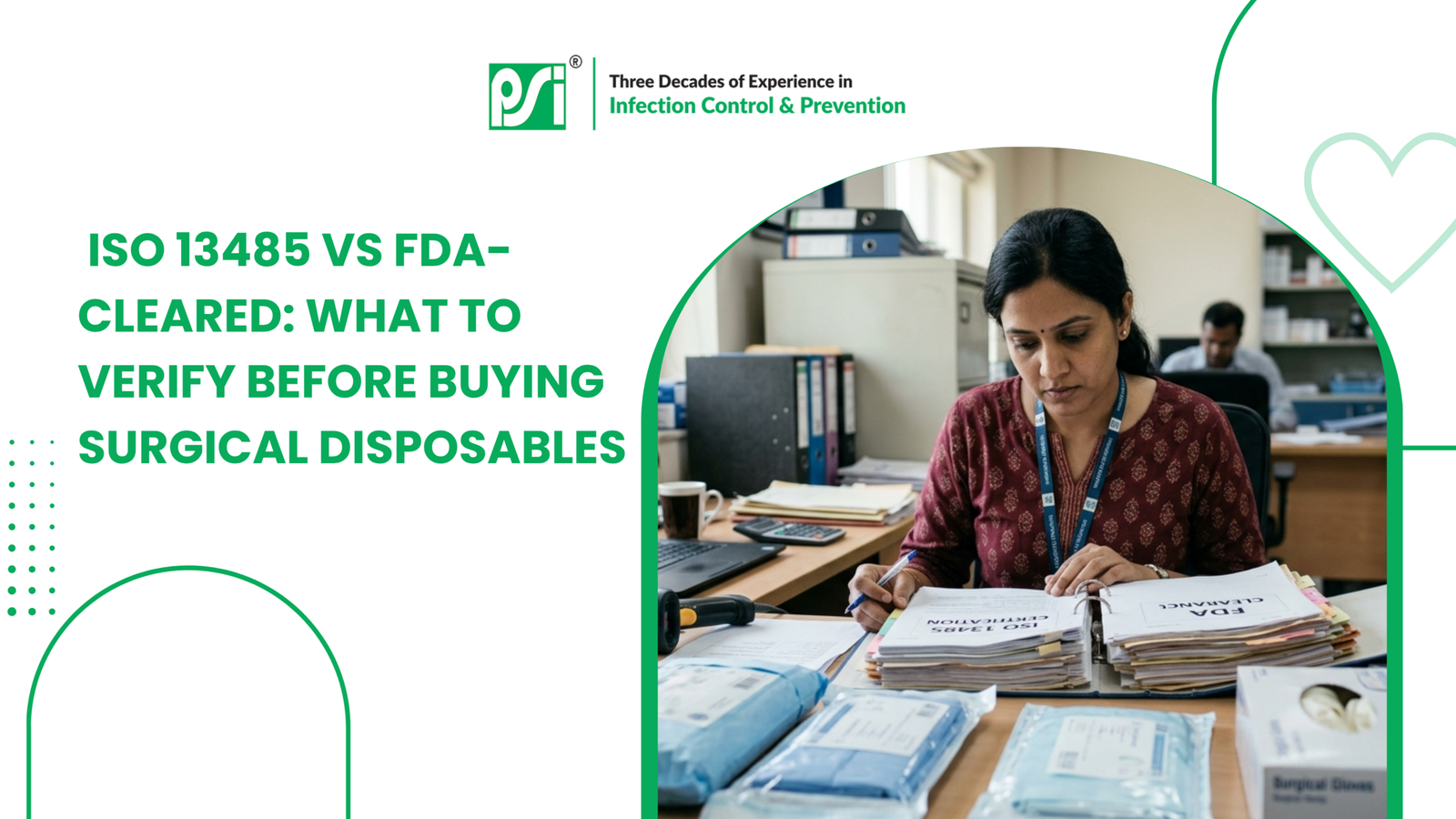
ISO 13485 vs FDA-Cleared: What to Verify Before Buying Surgical Disposables
A supplier says it is ISO 13485 certified. Another product says it is FDA-cleared.
Which one should a hospital swear by?
The question sounds simple, but the two terms mean very different things.
ISO 13485 focuses on the quality management system used by organisations involved with medical devices.
FDA clearance usually refers to a specific device completing an applicable US premarket review pathway, commonly 510(k).
Neither term should become a shortcut for assuming every product from a manufacturer meets every market requirement.
For hospitals, distributors, procurement teams, and healthcare organisations, verification matters.
Buyers need to check the manufacturer, individual product, intended use, regulatory status, testing, sterility, documentation, and applicable local requirements.
This becomes especially important when sourcing surgical gowns, drapes, procedure packs, protective apparel, and other medical disposables.
This guide clarifies the difference between ISO 13485 and FDA clearance.
It also provides a practical checklist for evaluating surgical disposables quality standards before placing institutional or bulk orders.
What Is ISO 13485?
ISO 13485 is an internationally recognised quality management system standard specifically designed for the medical device industry.
It solicits to organisations involved in areas such as:
- Medical device design
- Development
- Manufacturing
- Storage
- Distribution
- Installation
- Servicing
- Related medical device activities
An ISO 13485 medical disposables manufacturer uses a quality management system structured around medical-device regulatory and customer requirements.
The standard places significant prominence on areas including risk management, process control, documentation, traceability, and regulatory requirements.
However, ISO 13485 certification does not mean every product receives individual approval from ISO.
ISO itself does not certify companies.
Independent certification bodies perform certification.
What Does FDA-Cleared Mean?
“FDA-cleared” generally refers to a medical device that successfully finishes an applicable US clearance pathway.
The best-known example is 510(k).
Under this process, the manufacturer demonstrates substantial equivalence to a legally marketed predicate device.
The FDA reviews information relevant to safety and performance before making its substantial-equivalence determination.
If the requirements are satisfied, the device receives clearance for US marketing.
This is divergent from FDA approval.
That distinction matters.

FDA-Cleared Is Not the Same as FDA-Approved
These terms frequently become confused in medical product marketing.
A 510(k) device is FDA-cleared, not FDA-approved.
FDA approval generally refers to products reviewed through pathways such as Premarket Approval, or PMA.
PMA applies to certain high-risk devices and necessitates a different review standard.
Buyers should therefore be cautious when they see vague statements such as:
- “FDA certified”
- “FDA registered”
- “FDA approved facility”
- “FDA certificate available”
These phrases do not automatically demonstrate product clearance or approval.
Always ask what the claim specifically means.
ISO 13485 vs FDA Clearance: The Simple Difference
Think about the distinction this way:
ISO 13485 asks: Does the organisation operate an appropriate medical-device quality management system?
FDA clearance asks: Does this particular device meet the requirements of an applicable US clearance pathway?
They are an answer to different questions.
A simple comparison helps:
| Factor | ISO 13485 | FDA 510K Clearance |
| Main Focus | Quality management system | Specific medical device |
| Scope | Organisation and relevant QMS activities | Particular device |
| Market | Internationally recognised | United States |
| Issues By | Accredited/recognised certification body | US FDA |
| Product Approval? | No | Clearance, not PMA approval |
| Buyer should Verify | Certificate and scope | Device and clearance number |
Both can provide useful information.
Neither eliminates the obligation for detailed product verification.
Why This Matters When Buying Surgical Disposables
Surgical disposables directly interact with clinical environments.
Products may include:
- Surgical gowns
- Surgical drapes
- Procedure packs
- Dressing kits
- Protective apparel
- Sterile accessories
- Medical devices
- Other healthcare consumables
Different products have different intended uses and regulatory classifications.
That means procurement teams cannot evaluate every product using one certificate.
A surgical gown may need evidence relating to barrier performance.
A sterile product requires appropriate sterilisation validation and packaging controls.
Another device may require different performance or biocompatibility evidence.
The product determines what buyers need to verify.
What Should Indian Hospitals Verify?
For Indian hospitals, medical device certification India requirements deserve separate attention.
Medical devices in India operate under the applicable regulatory framework administered through CDSCO.
The Medical Devices Rules, 2017 provide the primary regulatory framework for medical devices in India.
Requirements can differ according to:
- Device classification
- Risk category
- Intended use
- Manufacturing status
- Import status
- Sterility
- Measuring function
- Applicable product standards
An international ISO certificate does not automatically replace these requirements.
Neither does FDA clearance.
Hospitals should verify the Indian regulatory status applicable to the particular product they purchase.
8 Things to Verify Before Buying Surgical Disposables
1. Verify the Manufacturer’s ISO Certificate
Do not simply accept an ISO logo on a website or brochure.
Ask for the certificate.
Check:
- Manufacturer’s legal name
- Manufacturing location
- ISO standard number
- Certificate number
- Certification body
- Issue date
- Expiry date
- Scope of certification
The scope matters.
A valid certificate should cover activities pertinent to the products being supplied.
2. Verify FDA Claims Separately
If a supplier claims a product is FDA-cleared, request the relevant clearance details.
Then verify them against the FDA’s official database.
Check whether:
- The manufacturer matches
- The product matches
- The clearance number is genuine
- The intended use is relevant
- The clearance applies to the product being purchased
Never presume an FDA establishment registration proves product clearance.
It does not.

3. Check the Exact Product Specification
Certificates provide only part of the purchasing picture.
Ask for the authentic product specification.
Depending on the disposable, review:
- Material
- Dimensions
- GSM where relevant
- Barrier performance
- Sterility
- Shelf life
- Packaging
- Size options
- Intended use
- Storage requirements
Specifications should match the hospital’s clinical requirement.
4. Verify Sterilisation
Sterile surgical products require another layer of verification.
Buyers should ask:
- What sterilisation method applies?
- Is the process validated?
- What standards apply?
- What is the shelf life?
- How is package integrity maintained?
- Is batch documentation available?
A product being manufactured under a quality system does not automatically answer these questions.
5. Review Product-Specific Testing
Different surgical disposables require different performance evidence.
For example, buyers evaluating gowns may need barrier-performance information.
Other products can require different mechanical, biological, or material testing.
Ask the manufacturer which standards apply to the exact product.
Then request supporting documentation where appropriate.
6. Check Traceability
What happens if a hospital identifies a problem with a particular batch?
Good traceability helps identify affected products.
Look for appropriate:
- Batch numbers
- Manufacturing details
- Expiry information
- Product identification
- Packaging information
- Quality records
Traceability becomes particularly important for large institutional purchases.
7. Evaluate Supplier Consistency
Certification alone cannot guarantee a smooth supply chain.
Hospitals also need reliable availability.
Ask about:
- Manufacturing capability
- Lead times
- Minimum quantities
- Batch consistency
- Customisation
- Packaging
- Export experience
- Supply continuity
A technically suitable product becomes less useful if deliveries repeatedly become unpredictable.
8. Compare Total Value, Not Just Unit Price
The lowest quotation is not automatically the lowest-cost solution.
Consider the complete procurement picture.
A better comparison includes:
- Product performance
- Compliance
- Documentation
- Packaging
- Reliability
- Usability
- Wastage
- Delivery
- Support
- Unit cost
This gives procurement teams a more realistic view of value.
A Simple Hospital Procurement Example
Consider a hospital comparing two surgical disposable suppliers.
Supplier A presents an ISO 13485 certificate and offers the lowest quotation.
Supplier B provides quality-system documentation plus detailed product specifications, testing information, traceability, and applicable regulatory documentation.
The hospital does not automatically select either supplier.
Instead, procurement verifies both sets of claims.
The team checks certificate scope, product requirements, regulatory status, testing, sterility, and supply capability.
Price becomes one part of the decision rather than the entire decision.
This is a stronger procurement approach.
Watch for the “FDA Registered” Trap
This deserves special attention.
A company can register its establishment with the FDA where applicable.
That does not mean the FDA approves the facility.
Device listing also does not mean a listed product receives FDA clearance.
The FDA itself warns that terms such as “FDA Registered” or “FDA Certified” can mislead buyers.
When evaluating FDA-cleared surgical products, ask for the authentic device clearance information.
Then verify it independently.
A Surgical Disposables Procurement Checklist
Before approving a supplier, procurement teams can utilise this checklist:
- Manufacturer identity verified
- Manufacturing location verified
- ISO 13485 certificate checked
- Certificate scope checked
- FDA claim verified where applicable
- Indian regulatory requirements checked
- Product specifications reviewed
- Sterility documentation reviewed where applicable
- Relevant testing reviewed
- Shelf life confirmed
- Batch traceability checked
- Packaging evaluated
- Supply capability assessed
- Samples evaluated where appropriate
- Commercial terms compared
This approach turns certification checking into practical supplier due diligence.
How Plasti Surge Industries Fits the Procurement Process
Plasti Surge Industries supplies a comprehensive portfolio of medical disposables and healthcare products.
Its range includes surgical gowns, surgical drapes, procedure packs, protective apparel, dressing kits, and customised healthcare solutions.
For hospital buyers, the important step is to evaluate the documentation applicable to the exact PSI product under consideration.
The same principle applies to every manufacturer.
Buyers should discuss product specifications, required standards, sterility, documentation, quantities, and intended applications before finalising institutional orders.
Conclusion
ISO 13485 and FDA clearance both matter in medical-device procurement, but they tell buyers different things.
ISO 13485 pivots on the manufacturer’s quality management system.
FDA clearance applies to a specific device and an applicable US regulatory pathway.
Indian hospitals also need to consider CDSCO requirements and the Medical Devices Rules when purchasing regulated medical products.
The strongest procurement process therefore goes beyond collecting certificates.
Substantiate the manufacturer, product, intended use, testing, sterility, traceability, regulatory status, and supply capability.
Plasti Surge Industries provides surgical disposables and healthcare products across multiple clinical categories.