AAMI Levels Explained: A Surgical Gown Buying Guide for Indian Hospitals
Does a Level 4 surgical gown automatically make it the best choice for every procedure?
Not at all.
Choosing the highest protection level for every situation can increase cost and potentially reduce comfort without providing meaningful additional benefit.
Opting for too little protection creates a more serious problem.
That is why hospital procurement teams need to understand AAMI level surgical gowns before comparing products and suppliers.
The AAMI PB70 classification system divides protective apparel into four barrier-performance levels.
Level 1 provides minimal barrier protection, while Level 4 represents the highest level within the classification.
However, Indian hospitals also need to consider applicable Indian standards.
BIS lists IS 17334:2025 for medical and surgical gowns and drapes.
So, procuring decisions should never rely on an “AAMI Level” claim alone.
This gown procurement guide explains Levels 1–4, where different protection levels may fit, and what Indian buyers should verify.
The objective is simple: match protection to clinical peril while considering comfort, compliance, documentation, reliability, and cost.
What Are AAMI Levels?
AAMI stands for the Association for the Advancement of Medical Instrumentation.
ANSI/AAMI PB70 establishes barrier-performance classifications for protective apparel and drapes used in healthcare facilities.
The system uses four levels:
- Level 1: Minimal barrier protection
- Level 2: Low barrier protection
- Level 3: Moderate barrier protection
- Level 4: High barrier protection
The levels help healthcare buyers compare liquid-barrier performance. https://www.fda.gov/
They do not mean every Level 4 garment is customarily appropriate for every clinical situation.
Why Do AAMI Levels Matter?
Healthcare workers face different exposure risks during different procedures.
A routine examination does not create the same fluid exposure as lengthy surgery.
Using one gown specification everywhere can therefore be inefficient.
Understanding isolation gown levels and surgical gown requirements helps hospitals match apparel with expected clinical exposure.
This aids:
- Appropriate barrier protection
- Better procurement decisions
- Improved wearer comfort
- More rational product selection
- Better cost control
- Clearer product specifications
Think of AAMI levels as a risk-based classification system rather than a simple quality ranking.
AAMI Level 1: Minimal Barrier Protection
Level 1 represents minimal liquid-barrier protection.
FDA examples for this level include:
- Basic care
- Standard isolation
- Visitor cover gowns
- Standard medical units
Level 1 products undergo testing for resistance to water impact.
They suit situations involving minimal predicted fluid exposure.
However, hospitals should always base gown selection on their own risk assessment and applicable requirements.
AAMI Level 2: Low Barrier Protection
Level 2 provides low barrier protection.
FDA examples include situations such as:
- Blood draws
- Suturing
- Intensive care
- Pathology laboratory activities
Testing requirements become more demanding than Level 1.
Level 2 assesses both water-impact penetration and hydrostatic pressure resistance.
This provides buyers with additional information about how the material performs against liquid exposure.
Again, Level 2 is not simply “better” than Level 1.
It serves a different risk category.
AAMI Level 3: Moderate Barrier Protection
Level 3 provides moderate barrier protection.
FDA examples include:
- Arterial blood draws
- Intravenous line insertion
- Emergency rooms
- Trauma cases
Level 3 uses more demanding liquid-barrier performance requirements than Level 2.
This makes it suitable where moderate fluid exposure is anticipated.
For procurement teams, Level 3 often requires careful evaluation of both protection and wearer comfort.
Healthcare workers still need to move freely while accomplishing demanding tasks.
AAMI Level 4: High Barrier Protection
Level 4 provides the highest barrier protection within the AAMI PB70 classification.
FDA examples include:
- Long procedures
- Fluid-intensive procedures
- Surgery with significant exposure
- Situations requiring pathogen resistance
- Certain suspected infectious-disease situations
Level 4 differs significantly from Levels 1–3.
The lower levels primarily use water-based barrier tests.
Level 4 requires testing involving resistance to penetration by blood-borne pathogens using a bacteriophage challenge.
This is an important distinction for procurement teams.
Level 4 should therefore constitute demonstrated performance, not simply a marketing description.
A Simple AAMI Level Comparison
Hospital buyers can remember the four levels like this:
| AAMI Level | Barrier Level | Typical Risk |
| Level 1 | Minimal | Minimal fluid exposure |
| Level 2 | Low | Low fluid exposure |
| Level 3 | Moderate | Moderate fluid exposure |
| Level 4 | High | High fluid and pathogen exposure |
This table provides a starting point.
Actual gown selection still depends on procedure-specific risk assessment and applicable standards.
Surgical Gowns and Isolation Gowns Are Not Indistinguishable
This distinction is important.
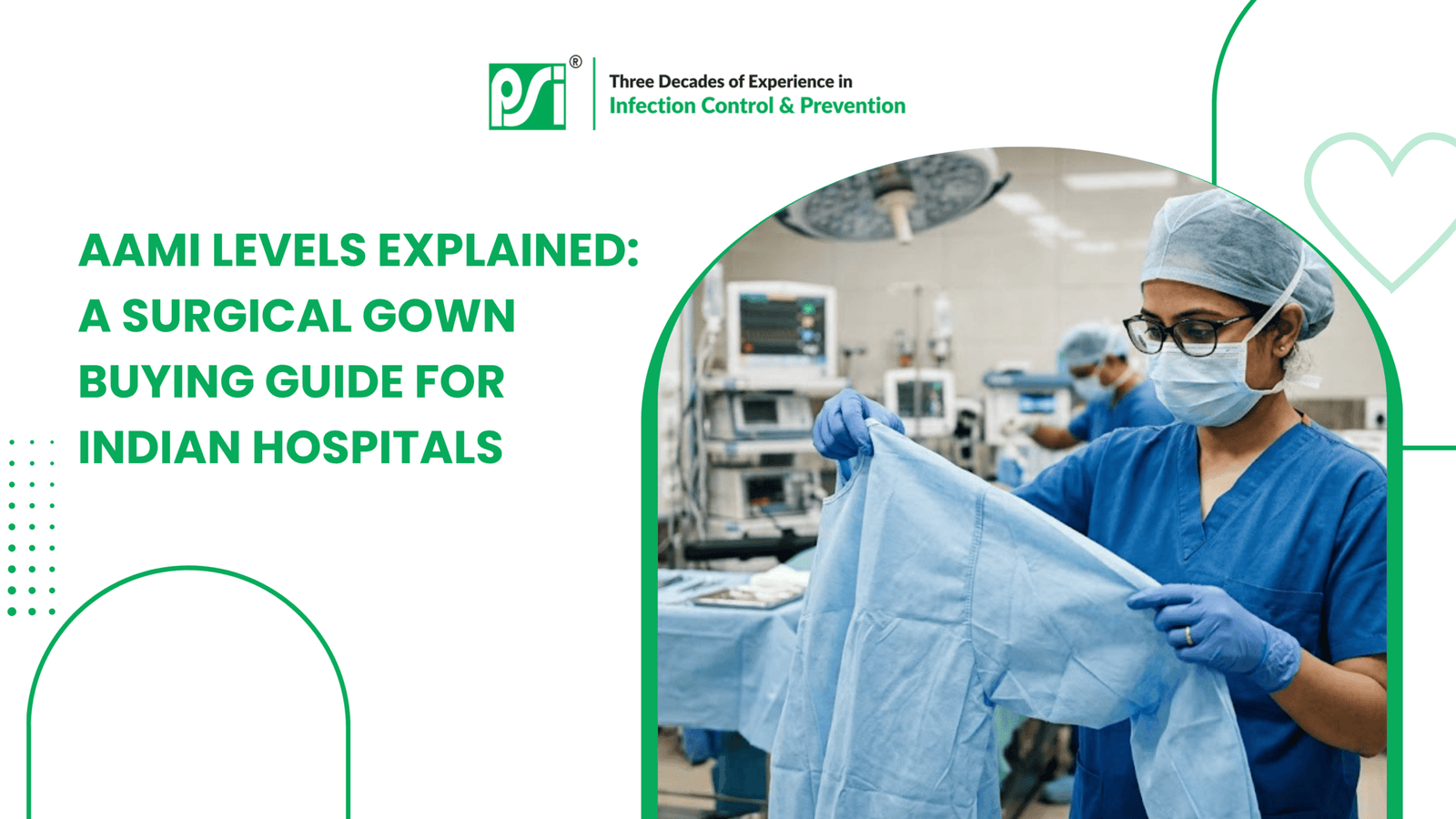
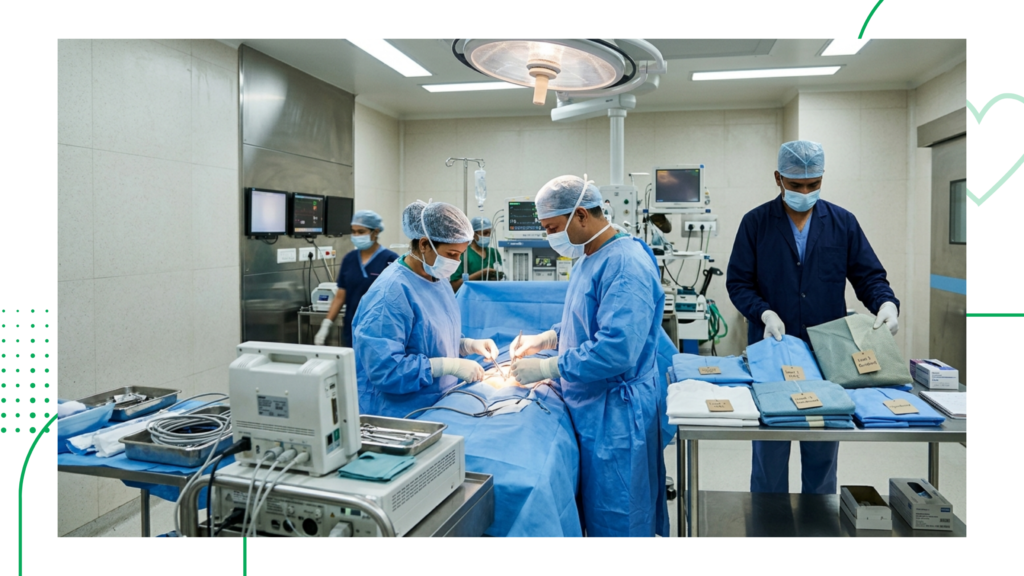
A surgical gown protects healthcare personnel and patients during surgical procedures.
Its critical protection zones receive particular attention.
An isolation gown serves different clinical applications and coverage requirements.
Hospitals should therefore circumvent treating isolation gown levels and surgical gown specifications as interchangeable purchasing terms.
Always verify:
- Intended use
- Garment design
- Critical protection areas
- Barrier level
- Sterility requirements
- Product labelling
- Supporting test documentation
The words printed on a supplier quotation are not enough.
What Are the Crucial Zones of a Surgical Gown?
Barrier protection is not simply about the fabric.
The location of protection matters.
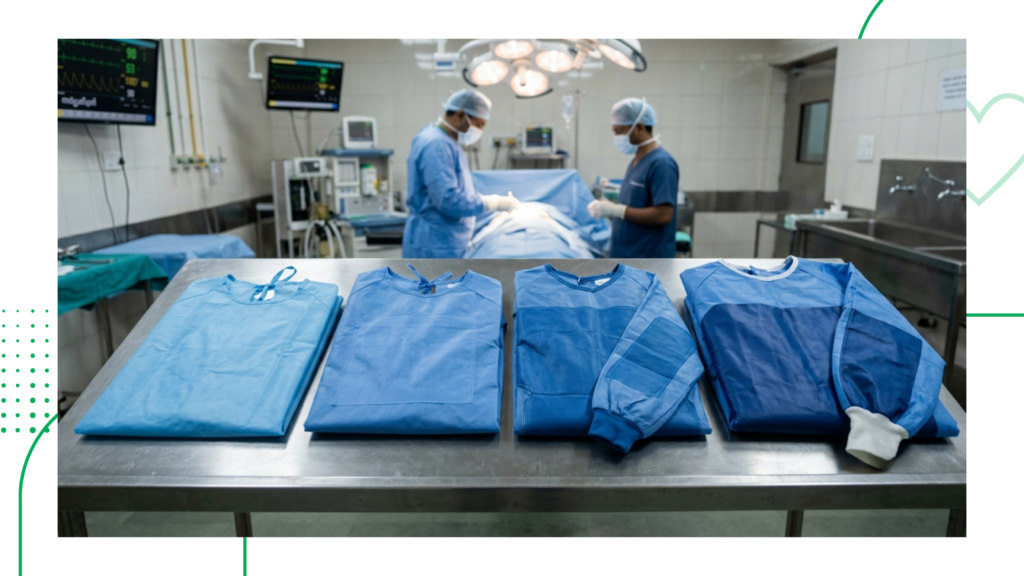
For surgical gowns, the front and portions of the sleeves form important critical protection areas.
These areas have greater potential exposure to blood and body fluids during surgery.
Seams and garment construction also matter.
Procurement teams should therefore ask how the complete gown performs, not simply request the fabric’s test report.
What Should Indian Hospitals Know?
Indian procurement teams need to consider more than international terminology.
The Bureau of Indian Standards lists IS 17334:2025 for medical/surgical gowns and medical/surgical drapes.
This is the first revision of the Indian Standard.
BIS testing information for IS 17334:2025 identifies testing across Levels 1, 2, 3 and 4.
Indian hospitals should therefore check the standards and regulatory requirements applicable to their specific procurement.
AAMI terminology can aid product comparison.
However, it should not replace applicable Indian requirements.
8 Questions to Ask Before Buying Surgical Gowns
A strong gown procurement guide goes beyond asking, “What AAMI level is this?”
Ask suppliers:
- What is the gown’s intended clinical use?
- What barrier level does it meet?
- Which standard supports that claim?
- Which laboratory performs the testing?
- Can you provide relevant test documentation?
- Is the gown sterile where required?
- What materials and reinforcement does it use?
- What sizes and configurations are available?
These questions make comparisons much more meaningful.
Do Not Choose a Gown by GSM Alone
GSM refers to grams per square metre.
It describes material weight.
It does not independently evince barrier performance.
A heavier fabric does not automatically provide a higher protection level.
Material construction, coatings, laminates, seams, reinforcement, and tested performance all influence protection.
Buyers should therefore avoid specifications based entirely on GSM.
Ask for performance evidence instead.
Comfort Still Matters
Healthcare workers may wear gowns during physically demanding procedures.
Protection cannot make the garment un-viable to work in comfortably.
Compare:
- Breathability
- Weight
- Sleeve movement
- Gown length
- Cuff design
- Neck closure
- Waist fastening
- Size availability
- Heat build-up
The objective is appropriate protection without unnecessary physical burden.
Example: Why One Gown Does Not Fit Every Department
Consider a multi-speciality hospital purchasing one high-barrier gown for every department.
The approach originally sounds safe.
However, clinical risks differ significantly.
Some teams encounter minimal fluid exposure.
Others perform long, fluid-intensive procedures.
The procurement team instead maps gown specifications against clinical activities.
Lower-risk applications receive appropriate lower-barrier apparel.
Higher-risk procedures receive gowns with stronger verified barrier performance.
The hospital now purchases according to risk rather than assuming “higher level equals better everywhere.”
This approach can support both protection and smarter procurement.
How to Build a Hospital Gown Procurement Matrix
Hospitals can create a simple purchasing matrix.
Step 1: List Clinical Activities
Identify where protective gowns are utilised.
Step 2: Assess Exposure
Estimate anticipated blood, fluid, and contamination exposure for each activity.
Step 3: Identify Required Protection
Match the clinical risk with the appropriate gown specification.
Step 4: Check Applicable Standards
Review AAMI classification alongside applicable Indian standards and regulatory requirements.
Step 5: Compare Documentation
Ask shortlisted suppliers for test reports and pertinent certification information.
Step 6: Evaluate Comfort
Where practical, obtain clinical feedback on fit, mobility, and usability.
Step 7: Compare Total Value
Evaluate price alongside protection, consistency, documentation, comfort, and supply reliability.
This creates a far stronger purchasing process than comparing unit prices alone.
Where Does PSI Fit Into Surgical Gown Procurement?
Plasti Surge Industries manufactures medical disposables and protective products for healthcare organisations.
Its portfolio includes several surgical gown configurations, comprising reinforced and procedure-oriented options.
PSI also manufactures protective apparel, surgical drapes, procedure packs, and other healthcare consumables.
This broader product portfolio is useful for institutional procurement.
Hospitals can discuss gown requirements alongside other operating-theatre consumables and customised procedure-pack requirements.
Buyers should request the exact specifications and supporting documentation for the PSI product being considered.
Conclusion
Understanding AAMI level surgical gowns makes hospital procurement easier, but the level number is only the beginning.
Level 1 provides minimal protection, while Levels 2 and 3 address progressively greater liquid exposure.
Level 4 provides the highest barrier category and includes pathogen-resistance testing.
Indian hospitals should also consider surgical gown standards India requirements, including the ongoing BIS framework.
The best gown is therefore not automatically the product carrying the highest number.
It is the gown with appropriate verified protection for the intended procedure.
Plasti Surge Industries provides surgical gowns, protective apparel, surgical drapes, procedure packs, and other medical disposables.